CertainTeed Monogram XL: How 25-Foot Vinyl Siding Panels Can Transform Your Home

When homeowners start planning a siding replacement, they usually focus on the things they're most excited about changing. They think about the new siding color, whether they want traditional clapboard or Dutchlap, whether to add board and batten or shake accents, and whether to replace their shutters, gutters, or exterior trim.
All of those decisions are important, and they can dramatically improve the appearance of a house. But there's another consideration that I believe deserves just as much attention, and it's one that homeowners rarely think about until after their new siding has been installed. The seams.

More specifically, the overlap seams created when one horizontal siding panel ends and another begins. On some houses, these overlaps are barely noticeable. On others, particularly large homes with long, uninterrupted walls, they can become one of the most noticeable features of the entire siding installation. And when the sun hits those walls at the right angle, the shadows created by those overlaps can make them stand out even more.
After more than 20 years in the siding business, I've come to believe that planning for these seams should be a major part of the siding selection process. That's one reason I'm particularly interested in CertainTeed Monogram XL, which offers extended-length siding panels measuring up to 25 feet. On the right house, these longer panels can virtually eliminate visible overlap seams from entire elevations, and in some cases, nearly the entire exterior.
Why Some Homeowners Are Surprised by the Seams in Their New Vinyl Siding
I've had customers who were excited to replace their old aluminum siding with new vinyl siding. They picked out a beautiful new color, upgraded the appearance of their home, and were genuinely happy with the finished project. But I've also had customers ask me afterward, "Hey, why do I have seams now?" It's an understandable question, especially when someone has spent thousands of dollars improving the exterior of their home.
The interesting thing is that their old aluminum siding had seams, too. They just weren't necessarily as noticeable. Aluminum siding is generally thinner than vinyl siding, and the way the panels overlap can create a flatter appearance at the joints. Vinyl siding is thicker and has a different panel design, which can make those overlaps more pronounced. The overlapping edge can create a small raised area that catches sunlight and casts a shadow, making the seam much easier to see.
This becomes particularly noticeable on the sides of houses where the sun shines directly across the siding. Depending on the orientation of the home and the time of day, a wall that looks nearly seamless in the morning might reveal every overlap in the afternoon. Darker siding colors can sometimes make these shadows even more noticeable, although the actual effect depends on the color, texture, lighting, and direction of the overlaps.
I don't think homeowners are warned about this often enough. We spend plenty of time helping people select siding colors, profiles, trim, shutters, and accent features, but the main siding itself will probably cover more exterior surface area than anything else. If there are dozens of unnecessary overlaps scattered across those walls, they can detract from an otherwise beautiful siding replacement.
What Makes CertainTeed Monogram XL Different?
Most traditional horizontal vinyl siding panels are approximately 12 feet long. If a wall is 20 feet wide, you generally need at least two panels to cover each horizontal course. If the wall is 35 feet wide, you'll generally need at least three. Every time one panel overlaps another, another seam is introduced into the finished exterior.
CertainTeed Monogram XL offers a much better alternative for many homes. It's a premium .046-inch vinyl siding product with a Rough Cedar texture, available in several extended lengths. The Double 4-inch clapboard profile comes in 16'8", 20', and 25' panels, while the Double 5-inch Dutchlap profile is available in a 16-foot length. These longer panels give installers the ability to cover much larger sections of a wall without creating unnecessary overlaps.

The Double 4-inch clapboard is available in 17 colors, while the Double 5-inch Dutchlap comes in 8 colors. That's fewer choices than CertainTeed's standard Monogram lineup, but it's still a substantial selection that includes many of the colors homeowners commonly choose. The important thing is to decide whether one of those colors works for your home before designing the project around the extended-length panels.
You can read more about the entire product lineup in our CertainTeed Vinyl Siding Review ↗, where I compare Monogram, CERTAplank, insulated siding, and other CertainTeed products with competing manufacturers.
Let's Look at How Monogram XL Could Work on a Typical Two-Story House
To understand why these longer panels can make such a difference, let's look at a hypothetical two-story house. Imagine a fairly typical colonial with a 36-foot-wide front, two side walls measuring 24 feet deep, and a 36-foot-wide rear elevation. The house has several windows on the front and back, a front entry door, and perhaps a sliding patio door at the rear.
With traditional 12-foot vinyl siding, a house like this could end up with a substantial number of overlap seams. But when you start looking at the house one elevation at a time, and consider where the windows and doors are located, you'll discover that many of those seams may be completely unnecessary.
That's where the 20- and 25-foot Monogram XL panels become particularly valuable.
The Sides of the House: Possibly No Seams at All
Let's start with the sides of our hypothetical house. Each side wall is 24 feet long, which is a fairly common dimension for a colonial-style home. With traditional 12-foot siding, every uninterrupted horizontal course would require multiple panels, creating at least one overlap. Over the height of a two-story house, that could mean dozens of seams on each side.

Now consider what happens when we use 25-foot Monogram XL panels instead. A single panel can potentially cover the entire 24-foot wall from corner to corner, allowing for the required installation clearances. That means every uninterrupted course could be installed without a single overlap seam. If the wall has 25 or 30 horizontal courses, we've potentially eliminated 25 or 30 seams on that one elevation.
And remember, there are two sides to the house. We could potentially eliminate 50 or 60 overlap seams just by choosing a different panel length. That's a dramatic difference in appearance, especially when those side walls are exposed to direct sunlight.
Of course, not every house is exactly 24 feet deep. Some are 20 feet, some are 22 feet, and others are 26 or 28 feet. But many homes have side walls that fall within the 25-foot limit, making them excellent candidates for a completely seam-free appearance. Even a 20-foot panel could accomplish the same thing on a slightly shorter house.
This is also why I believe the sides of the house deserve particular attention. They're often among the longest uninterrupted siding runs, especially when there are few windows or other openings. And because they're large, relatively flat surfaces, visible overlaps can become much more noticeable than they would on a wall with more architectural features.
The Front of the House: Windows, Doors, and Architectural Features Help
The front of a house is usually a different situation. Even though the overall width of our example house is 36 feet, that doesn't necessarily mean we have a continuous 36-foot siding run. Most front elevations have multiple windows, a front door, perhaps a garage, and sometimes other architectural features that divide the siding into smaller sections.

These openings can work to our advantage. A window interrupts the siding courses that pass through it, allowing separate pieces of siding to terminate into the window trim rather than overlap one another. The same is true for doors and other openings. With careful planning, we can often use longer panels to cover the remaining wall sections without needing additional overlaps.
For example, imagine a front elevation with windows spaced across the first and second floors. Many of the siding runs between those windows might be only 6, 10, or 15 feet long. A 16'8" or 20-foot Monogram XL panel could cover those sections without any overlap at all. Even where the siding runs above or below the windows, a 25-foot panel may be long enough to eliminate seams that would otherwise be necessary.
The front of the house is also where homeowners often incorporate decorative accents. Board and batten siding in a gable, shake siding around an entryway, or contrasting trim can break up the horizontal siding into smaller sections. These design features can improve the overall appearance while also reducing the number of long, uninterrupted siding runs.
We've explored these design possibilities in our article about Creative Ways to Use Vertical or Shake Vinyl Siding as an Accent Feature ↗.
With the right combination of panel lengths, window placement, and architectural features, it's entirely possible for the front of a house to have very few visible overlap seams, or potentially none at all.
The Back of the House: Usually the Biggest Challenge
Now we get to the back of the house, which is often where the longest uninterrupted siding runs occur. On our hypothetical colonial, the rear elevation is 36 feet wide. Depending on the design, there might be a sliding patio door, a few windows, and large sections of uninterrupted wall extending across much of the house.
This is where the limitations of even 25-foot siding panels become apparent. A single 25-foot panel obviously can't cover a continuous 36-foot wall, so some overlaps will still be necessary. But that doesn't mean we should accept the same number of seams that would be created with traditional 12-foot panels.
Consider a 36-foot uninterrupted siding run. Using standard 12-foot panels, we would generally need four pieces per course once the necessary overlaps and clearances are accounted for. That's three overlap seams on every full-length course. Using 20- or 25-foot Monogram XL panels, we could potentially cover that same run with only two pieces, reducing the number of overlaps to just one per course.

That's a reduction from three seams to one on every uninterrupted course. Across 20 courses, we've reduced the number of overlaps from approximately 60 to 20. That's 40 fewer seams on a single wall section, simply by using longer panels.
But we can often do even better by taking advantage of windows and doors. A sliding patio door, for example, interrupts several courses of siding, potentially dividing a long wall into two shorter sections. Windows on the second floor can accomplish the same thing. By carefully planning where the panels begin and end, we may be able to eliminate additional overlaps that would otherwise appear in those areas.
On a large two-story house, I would still expect some seams on the back, particularly above or below openings where the siding runs continuously across the wall. But there's an enormous difference between having a handful of carefully positioned seams and having dozens of unnecessary overlaps scattered across the entire elevation.
The goal isn't necessarily to eliminate every seam. It's to eliminate every seam that doesn't need to be there.
Why Proper Seam Staggering and Overlap Direction Still Matter
Even with extended-length siding, there will be situations where overlaps are unavoidable. When that happens, the installer still needs to pay attention to seam placement, staggering, and the direction of the overlaps. These details can make the remaining seams considerably less noticeable, particularly when the siding is viewed from the street or other common viewing angles.
One common technique is to orient the overlaps so that the exposed edge faces away from the most important viewing direction. On a side wall, for example, we generally prefer to have the front panel overlap the rear panel so the seam is less noticeable when viewed from the front of the house. This doesn't make the seam disappear, but it can reduce how prominently it stands out.
Staggering the seams between courses is also important. You don't want a vertical line of overlaps running straight up the side of a house. Properly staggered seams help distribute the joints across the wall, creating a more natural appearance. However, even well-staggered seams can remain visible when the sun casts shadows across the overlapping edges.
I've covered these installation techniques in much greater detail in our article How to Minimize, Hide, or Altogether Get Rid of Vinyl Siding Seams ↗. It's a useful companion to this article because it explains what installers can do when seams can't be eliminated through panel length alone.
My preference is to use the longest practical panels first, eliminate as many overlaps as possible, and then carefully plan the placement of whatever seams remain. That approach addresses the problem before relying on techniques to make the seams less noticeable.
Could You Really Have a House With Almost No Vinyl Siding Seams?
On the right house, absolutely. Think back to our hypothetical two-story colonial with 24-foot side walls, a front elevation broken up by windows and doors, and a 36-foot rear elevation. By using 25-foot panels on the sides, we could potentially eliminate every overlap on both side elevations. On the front, we could use the windows, doors, and architectural features to reduce or eliminate most of the remaining seams.
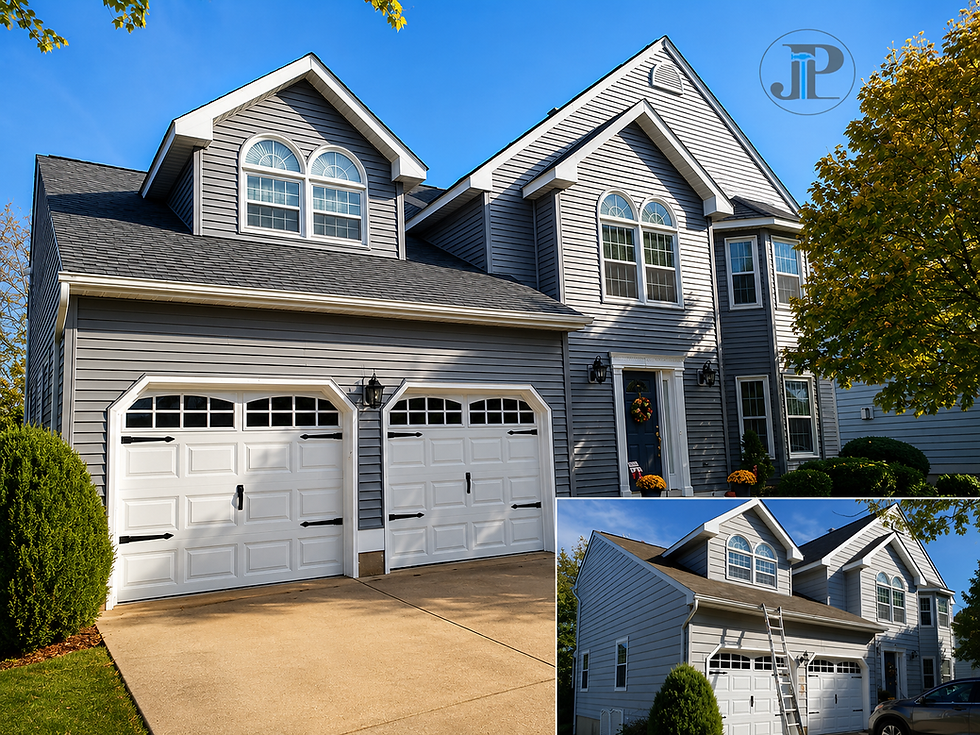
That leaves the back of the house, where a few overlaps would likely still be necessary on the longer uninterrupted courses. But even there, extended-length panels could eliminate a large percentage of the seams that would otherwise be present. With thoughtful planning, the finished house could have dramatically fewer visible overlaps than the same home sided with standard 12-foot panels.
This is why I think homeowners should look beyond the usual siding choices. Yes, the color matters. The profile matters. The thickness, texture, trim, shutters, and accent features all matter. But if you're spending thousands of dollars replacing the material that covers most of your exterior walls, shouldn't you also consider how many visible seams that material is going to have? I certainly would.
Are There Any Disadvantages to 20- and 25-Foot Vinyl Siding Panels?
There are some practical considerations. Longer panels are more difficult to transport, handle, and install, particularly on homes with limited access or tight working areas. They require careful handling to avoid damage, and installers need to follow CertainTeed's specific instructions for fastening, expansion and contraction, and center pinning where required. A 25-foot piece of vinyl siding expands and contracts more in total length than a shorter panel, so proper installation is especially important.
Product availability is another consideration. Although CertainTeed offers the 20- and 25-foot Double 4-inch clapboard panels in 17 colors, that doesn't mean every distributor stocks every color and length. Longer panels may require special ordering, minimum quantities, or additional lead time. Before committing to a particular color or panel length, we would need to confirm availability and ordering requirements with our supplier.
There may also be additional costs associated with the longer panels, including material pricing, delivery, handling, and installation. On some houses, those costs may be worth paying to eliminate dozens of visible seams. On others, particularly homes with many short wall sections, the longer panels may provide relatively little benefit. I wouldn't automatically recommend the most expensive option without first looking at the actual layout of the house.
And there's one important limitation to understand: the 20- and 25-foot panels are available in CertainTeed's Double 4-inch clapboard profile, not its Double 5-inch Dutchlap. Homeowners who prefer Dutchlap can still benefit from the 16-foot Monogram XL option, but they won't have the same ability to span a 20- or 25-foot wall with a single panel. That profile choice needs to be part of the discussion from the beginning.
For a broader comparison of siding grades, profiles, and costs, see our article Choosing the Right CertainTeed Horizontal Siding: Encore, MainStreet, or Monogram ↗.
Why I Think Monogram XL Deserves More Attention
I think Monogram XL is one of those products whose benefits become obvious once someone explains what it can actually accomplish on a house. Most homeowners don't know that 20- and 25-foot vinyl siding panels exist. They certainly don't know that choosing those panels could potentially eliminate every overlap seam on both sides of their house, or that the placement of their windows and doors could help eliminate additional seams on the front and back.
Instead, they usually focus on the choices they've been conditioned to think about: color, thickness, style, trim, shutters, and other exterior improvements. Those are all worthwhile considerations, but none of them necessarily addresses the appearance of the overlap seams in the main siding itself. And once the siding has been installed, there's no simple way to eliminate those seams without replacing the affected panels.
I've always believed that a siding replacement should be planned as a complete exterior project, not just a matter of selecting a product and covering the walls. That means considering insulation, flashing, trim details, ventilation, colors, architectural accents, and the finished appearance of the siding itself. In fact, I've written about the ideal siding replacement project if it were my own house ↗, including many of the choices I would make when planning a complete exterior renovation.
For me, minimizing visible seams belongs near the top of that list. It's something homeowners may not appreciate until they see the difference, but once they do, it can completely change the way they look at vinyl siding.
Before You Replace Your Siding, Think About the Seams
If you're considering new vinyl siding, I would encourage you to look at your house a little differently before making your final selections. Walk around the exterior and pay attention to the lengths of the walls, the placement of the windows and doors, and the areas where the sun tends to highlight the existing siding. Think about which walls could potentially be covered with a single 20- or 25-foot panel and which areas might still require overlaps.
You may discover that both sides of your house could be completely free of overlap seams. You might find that the front has enough windows and architectural features to eliminate nearly all of them. And even if the back of your house has a few long, uninterrupted walls, careful planning and extended-length panels could still dramatically reduce the number of visible joints.
At JP Construction Services, we've spent more than 20 years helping homeowners throughout Maryland and Pennsylvania improve the appearance and performance of their homes. CertainTeed is our preferred siding manufacturer, and Monogram XL is a product I believe deserves serious consideration when the goal is to achieve a cleaner, more continuous exterior appearance.
A beautiful new siding color can transform your home. But eliminating dozens of unnecessary seams can make that transformation look even better.

If you live within our service area, call us today at (877) 846-9566 to schedule your free in-person siding consultation. You can also schedule online or get your custom siding quote with our free online Siding Estimate Calculator.